
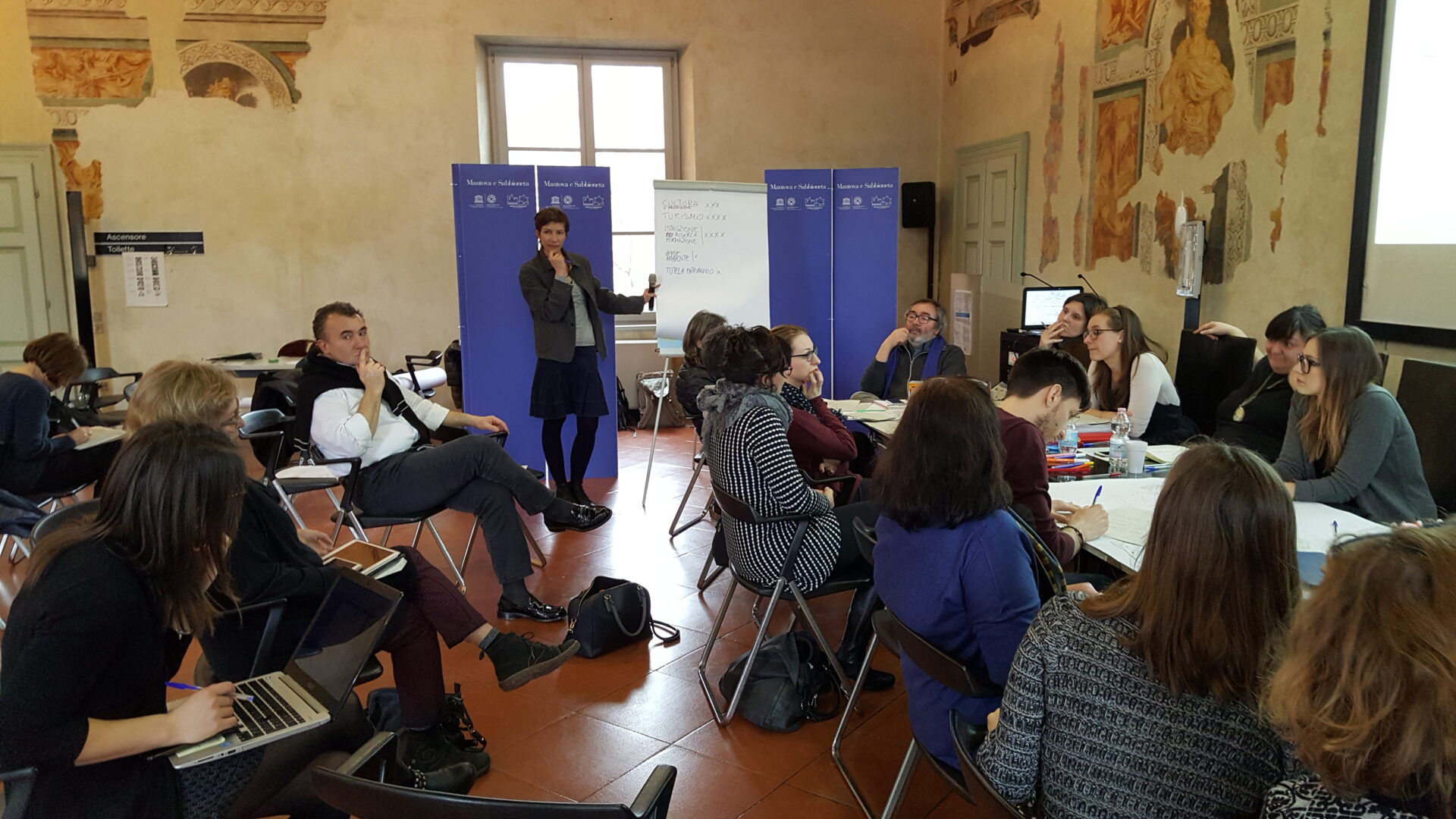
There participation of local communities and key stakeholders is increasingly important in the management policies promoted by UNESCO for the sites World Heritage.
For this reason, at various levels, the Office has experimented with participatory experiences, trying to involve local subjects and citizens as much as possible in the planning and management of activities to understand, safeguard, protect and enhance the site.
Examples of these experiments are the Mantua and Sabbioneta Heritage Center they Participation meetings for the Management Plan.
The Management Plan finds its raison d'être when it involves the Site's actors to increase their awareness and the responsibility in the protection of its values.
THE'Mantua and Sabbioneta World Heritage Office It thus initiated a process of sharing, stakeholder involvement, and public participation. This intersectoral and multifaceted process took the form of stakeholder consultation with specifically dedicated meetings, held in two successive phases:
First phase – THE DIALOGUE TABLES
Mainly consultative in nature, the first phase involved 47 subjects on various topics concerning the management of the Site, through the collection of proposals indicated by the stakeholders as fundamental for the development opportunities of the Site itself.
Specifically, the discussions aimed to promote: understanding the exceptional value of the site; sharing research and studies useful for its conservation; analyzing critical issues and the adequacy of existing protection measures; analyzing tools for managing natural and man-made risks; analyzing the livability of the two historic centers and their use; and analyzing projects promoted by various stakeholders to address emerging risks.
Second phase – DAYS OF DEBATE AND IN-DEPTH EXPERIENCE
Of a laboratory nature, this second phase was aimed at exploring the themes that emerged in the previous phase and at highlighting the different priorities for intervention. For each day, each dedicated to a specific theme, a Focus Group And Open lessons to citizens, with the involvement of experts and institutional representatives, cultural and trade associations.
UNESCO SITE AND PUBLIC SPACES
Qualification of urban and peri-urban spaces and connections – public spaces, historic squares, green areas, waste areas, cycle/pedestrian systems – as coherent and fundamental parts of the World Heritage Site
UNESCO SITE AND ENVIRONMENTAL SYSTEM
Structuring an environmental management system aimed at reconciling the protection with the use and recognition of an integrated heritage of the UNESCO Site
UNESCO SITE AND VALUE CHAIN
Recognition and strengthening of the value chains (social, cultural, economic, tourist, commercial, productive, educational, etc.) connected to the UNESCO Site 'brand' and activation of new derivative economies
UNESCO SITE AND MANAGEMENT SYSTEM
Activation and consolidation of mixed partnerships (public, private, third sector, and social private) for the integrated management and active conservation of the site's monumental and environmental heritage.