
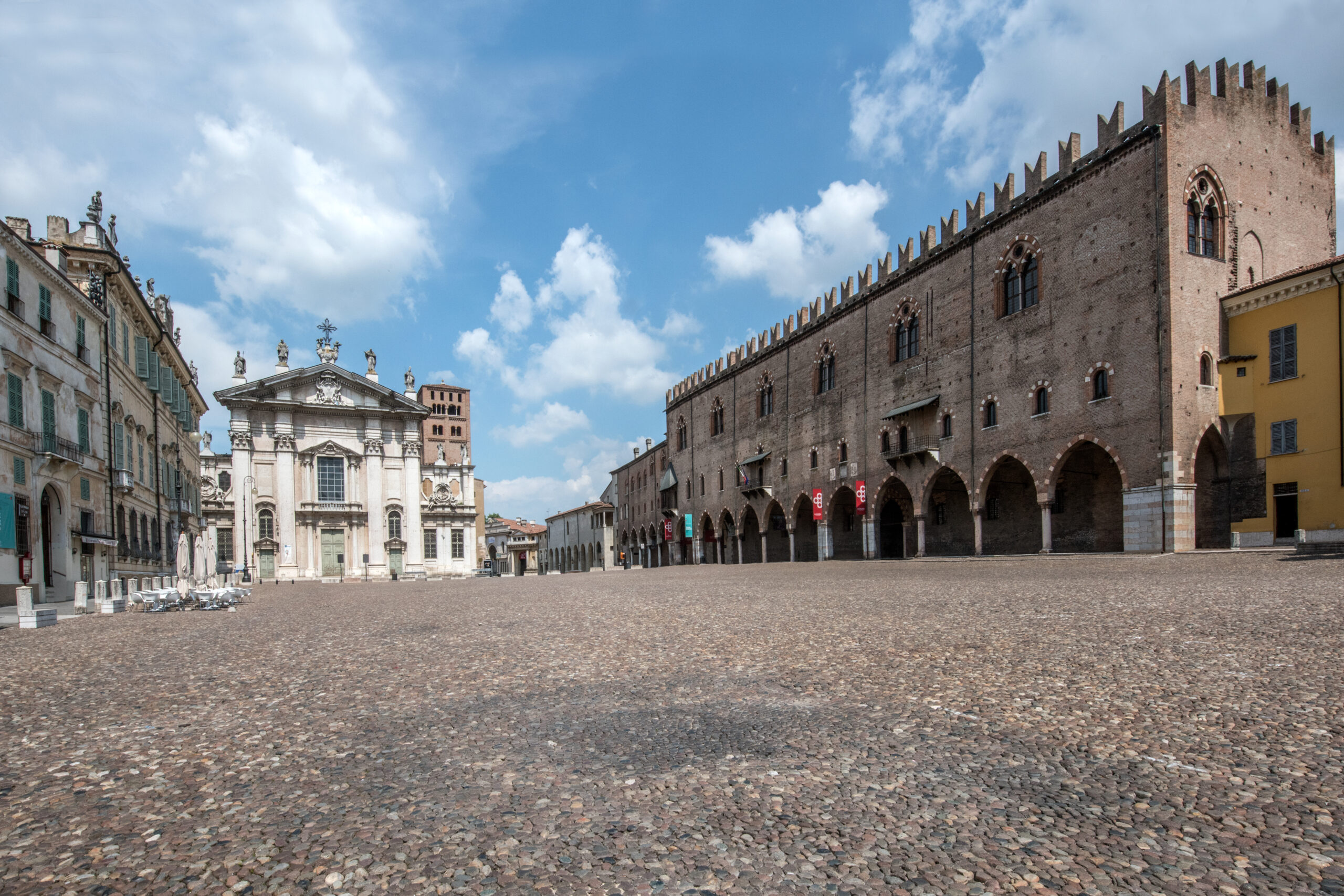
The city of Mantua developed in the Etruscan-Roman period starting from the Civitas Vetus, old city, which roughly corresponds to the area of the current Sordello Square, delimited by the oxen ditch (today via Cavour and via Accademia) which corresponded to the first circle of walls. Outside Piazza Sordello, there was countryside, crossed only by Roman roads lined with a series of funerary shrines now preserved in the archaeological museum. The rest was covered by woods and water, a single lake that surrounded the city.
The evolution of the city began in the Middle Ages, towards the south, when the Erbe and Broletto squares and the related palaces of power were built and the second circle of walls at the height of the Rio, the watercourse created in the 12th century by Alberto Pitentino. At that time, Piazza Sordello was a neighborhood, full of tightly packed houses that remained vibrant until the end of the 14th century. Outside the square were small villages, each with its own church and community, separated by the marshy areas that characterize the Mincio valleys.
In the 15th century the city expanded further and Francesco Gonzaga had the third circle of walls. New roads were created, lined with noble palaces, reaching a countryside area divided by the Fossa Magistrale (currently Viale Risorgimento and Viale della Repubblica). Here we would have seen water, many trees, and two islands. On what was known as Tilietum, a new canal was built. Te Palace by architect Giulio Romano. These are the years of suburban villas built outside the city as places of leisure and recreation.