
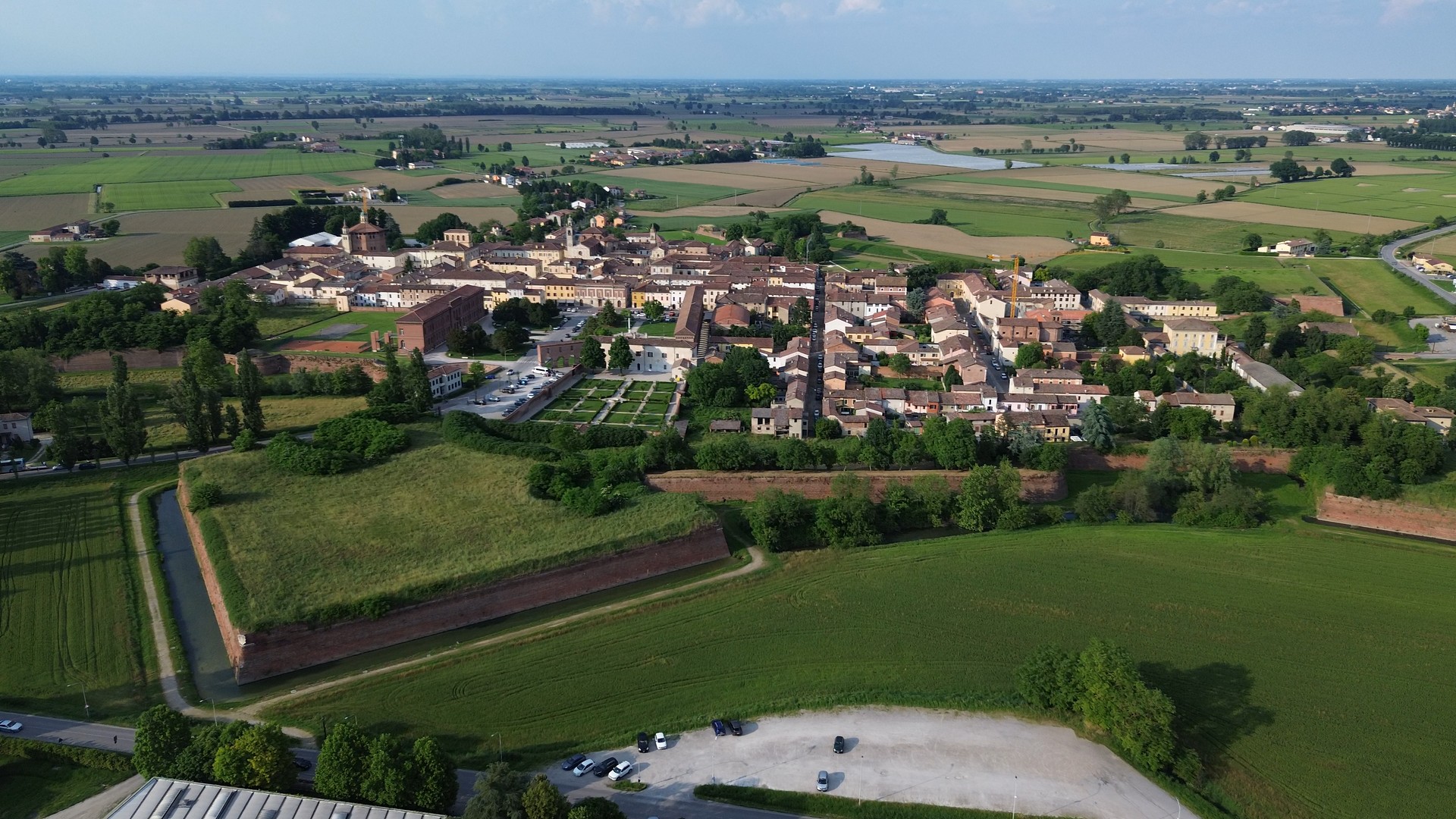
Sabbioneta represents, in relation to Mantua, the implementation of Renaissance urban planning principles
based on the search for symmetry and rigor, through the construction of a new city, the result of a precise and complete design will.
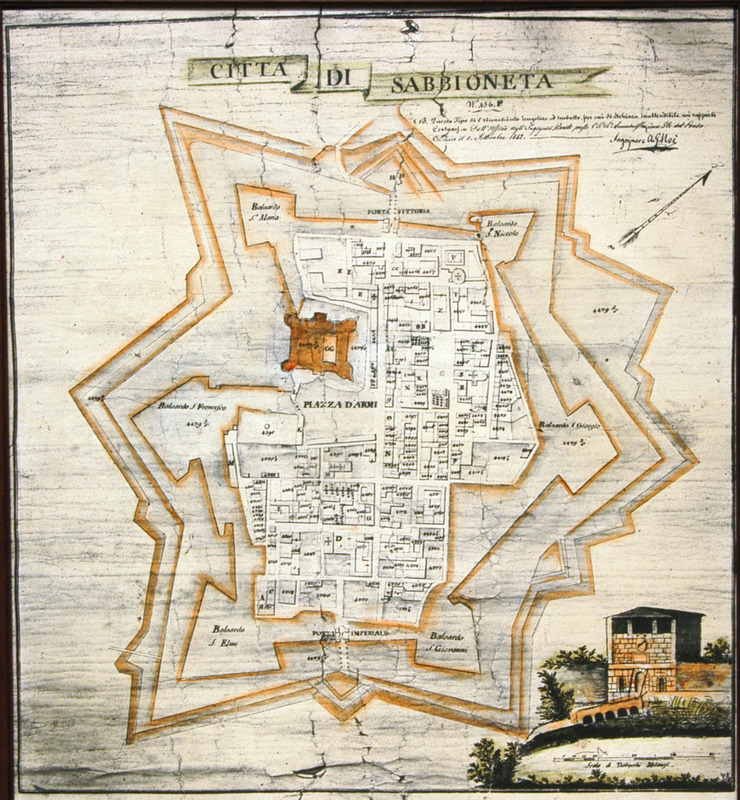
Sabbioneta with Imperial Gate, AG Noè, 1842 (Council Chamber, Municipality of Sabbioneta).
Sabbioneta, as its name suggests, was founded on alluvial deposits from the Oglio and Po rivers. Later, in the 11th century, Benedictine monks began a reclamation process. On the dry sand Vespasian Gonzaga, who boasted among his skills that of a military architect, built his ideal city.
This concept is expressed in the statue of Leone Leoni preserved in the church of the Incoronata, in which the duke symbolically places his foot on a small layer of sand.
Recovering the principles of the’classical art, Vespasian designed a layout similar to the Roman castra, with 36 regular quadrangular blocks divided into orthogonal streets. The city walls are shaped like an irregular hexagon, with six wedge-shaped bastions at the corners and two monumental gates for access. To disorient invaders, the main road axis was broken near the gates. The synthesis between aesthetics and defense is perfectly achieved here.