
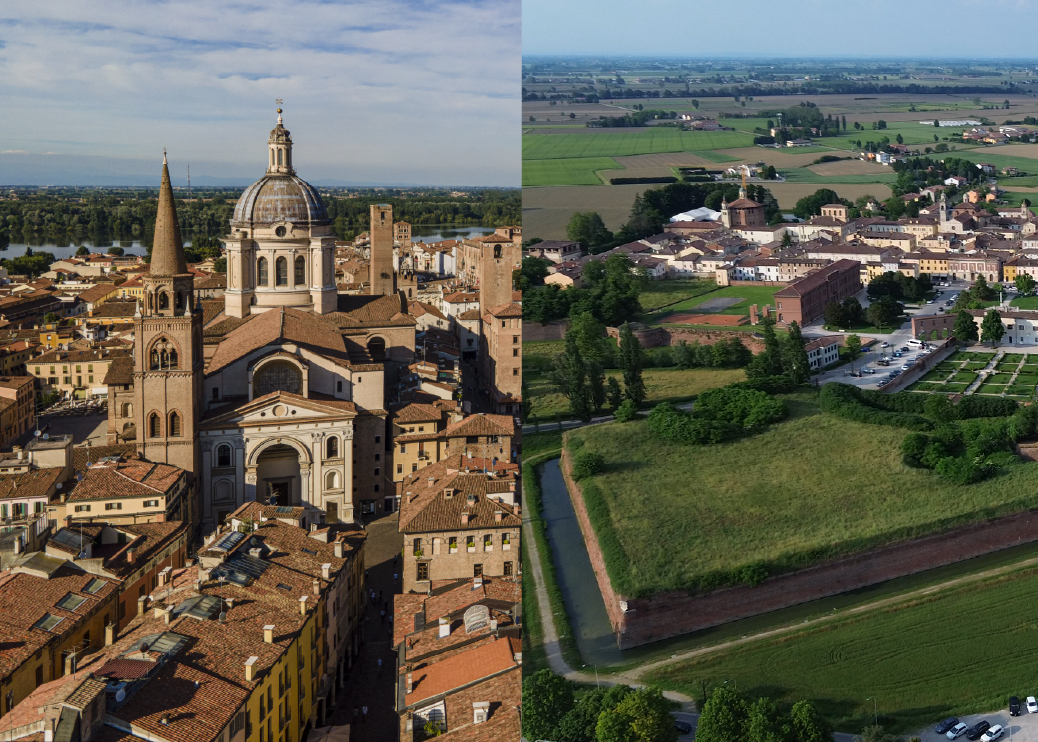
The site Mantua and Sabbioneta has been included in the World Heritage List, on the basis of the recognition of a Universal Outstanding Value linked to the exemplary territorial planning and urban planning interventions carried out in the two cities during the Renaissance by the ruling family, the Gonzagas.
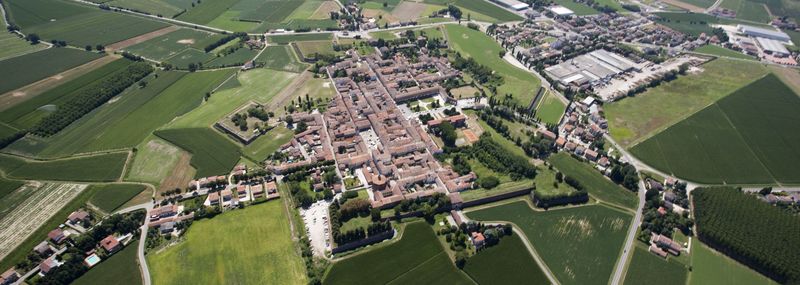
Sabbioneta from above (photo by Danilo Malacarne)
Sabbioneta is the emblem of the newly founded city, designed and built by Vespasian Gonzaga in the second half of the sixteenth century as the perfect capital of its Duchy;
Mantua presents itself as the transformation of an existing city which changed the ancient urban fabric, of Etruscan-Roman foundation and modified during the Middle Ages, to adhere to Renaissance urban planning ideals.
Two different and complementary urban planning models but a single site, a cultural heritage of the past to be safeguarded and passed on to future generations.
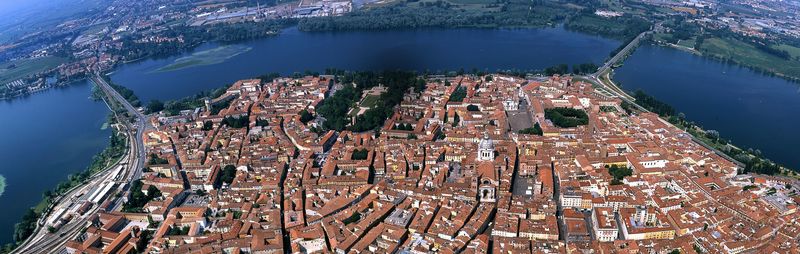
Mantua from above (photo by Roberto Merlo)
Mantua and Sabbioneta They represent two exemplary and original urban entities in the panorama of the courts of the European Renaissance, whose characteristics are linked to the personality of masters such as Victorino of Feltre, of humanist artists such as Leon Battista Alberti, Andrea Mantegna And Julius Romano, of extraordinary architect princes, from Louis II to William, up to Vespasian Gonzaga.
However, more than the individual works, it is the organic whole of the different constituent elements that provides the key to understanding the site's exceptional nature.
Mantua and Sabbioneta emerge as two perfect bodies where each single element finds its meaning in relation to the others. Furthermore, the two different urban planning processes make the site an exemplary model capable of encompassing all the Renaissance urban planning forms.