
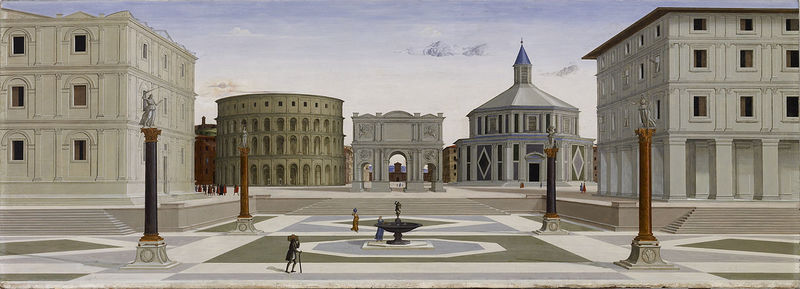
Since ancient times man has given a symbolic importance and an aesthetic sense to the place where he has lived. Greek era And Roman, through the canons of beauty and harmony, have identified the city as a real expression of the philosophical and artistic treatises theorized in different fields. Examples of this are the cities of Thurii founded by Pericles and the Etruscan Marzabotto.
In the Middle Ages, especially in the so-called communal age, the city represented the will of the Signoria and the families who governed it, dividing the urban space into symbolic and functional places of representation, defense, residence, and entertainment. The walls were the element separating order from chaos, protecting citizens and allowing them to carry on their activities.
In the'’Humanism The rediscovery of ancient values and the theorization of perspective gave cities a new impetus, initiating a process of comparison with the ideal cities of the past, above all Rome and Athens. Philosophers and architects initially theorized the ideal city only on paper (as in the case of Sforzinda dedicated to the Duke of Milan Francesco Sforza) and subsequently applying geometric and mathematical rules to build it.
Furthermore between the 15th and 16th centuries, the political and military tension that characterizes the Italian territory, leads urban planners and treatise writers to formulate a new concept of fortification that combines the aesthetic ideal with the military and defensive one.
From the Four hundred, to align with the models and principles of antiquity, we witness the design of two types of cities: the reorganization of the previous medieval fabric (transformation) and the new construction (foundation). Such interventions can be specific as the Palace of Urbino and the Pienza square or extend to an entire part of the city as Ferrara.
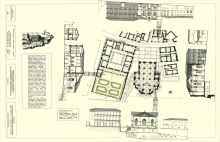
Plan of Piazza Pio II, Pienza
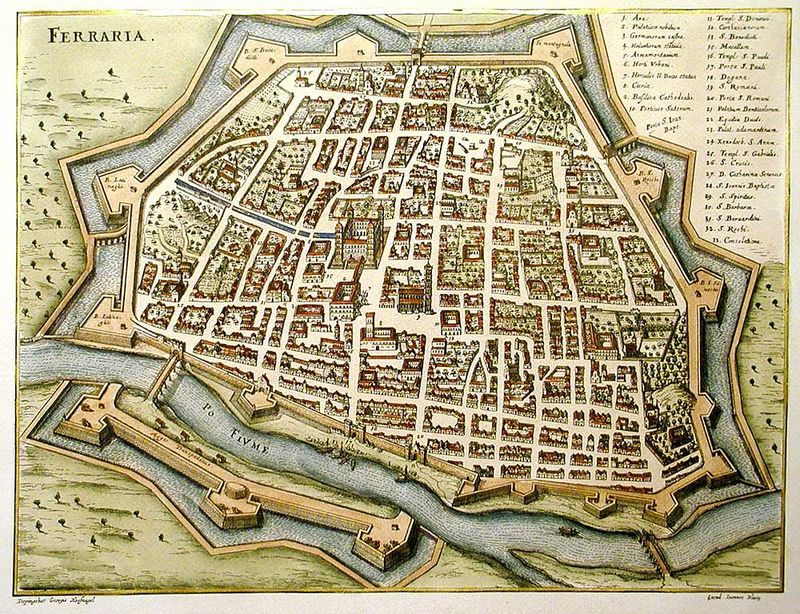
Map of Ferrara
The Lords of the various Courts commissioned the design of the most representative architects, artists and urban planners such as Bernardo Rossellino, Luciano Laurana, Francesco di Giorgio Martini, Leon Battista Alberti and Biagio Rossetti.
Also Mantua, governed by the Gonzaga family, fits into this process of comparison with the ideal city and the reworking of classical values. The Gonzaga family of the main lineage aimed above all to regularize the forms and enrich the already monumental aspect of the medieval city. While the Gonzaga of the cadet branches implemented a different policy aimed at creating a modern, defended, foundational city. This is the case of Sabbioneta And Guastalla where Vespasiano and Ferrante Gonzaga applied the principles of the ideal city to a context of smaller size and prestige than Mantua and yet promoters of new city-states capable of competing and relating to the major European powers.
The only exception to building in the city is represented by Duke Vincenzo I Gonzaga who founded the city-state of Casale Monferrato. Built according to the principles of the ideal fortified city, Casale served primarily as a military outpost at the center of political conflicts between Spain and France. It was demolished in just two months in 1695.
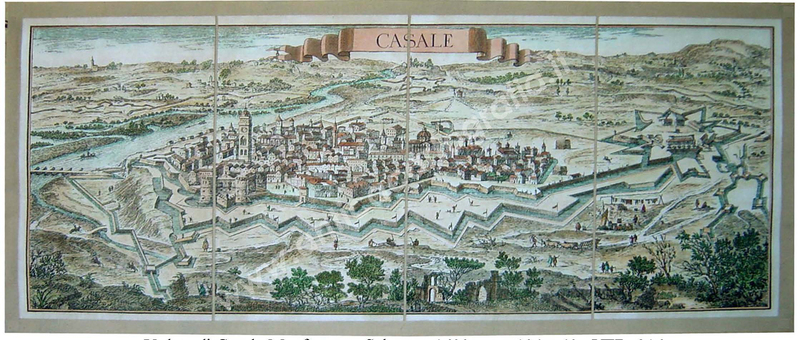
Farmhouse Plan
Likewise, Charles I Gonzaga of Nevers founded a city and gave it his name: Charleville.
Guastalla and Charleville They represent the principles of the ideal city because they put theoretical concepts into practice, embody the value of good living, and elevate the dignity of their founder to a mythical figure.
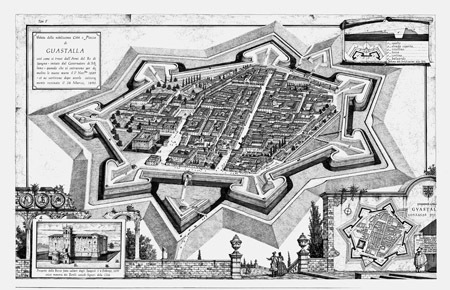
Guastalla plan