
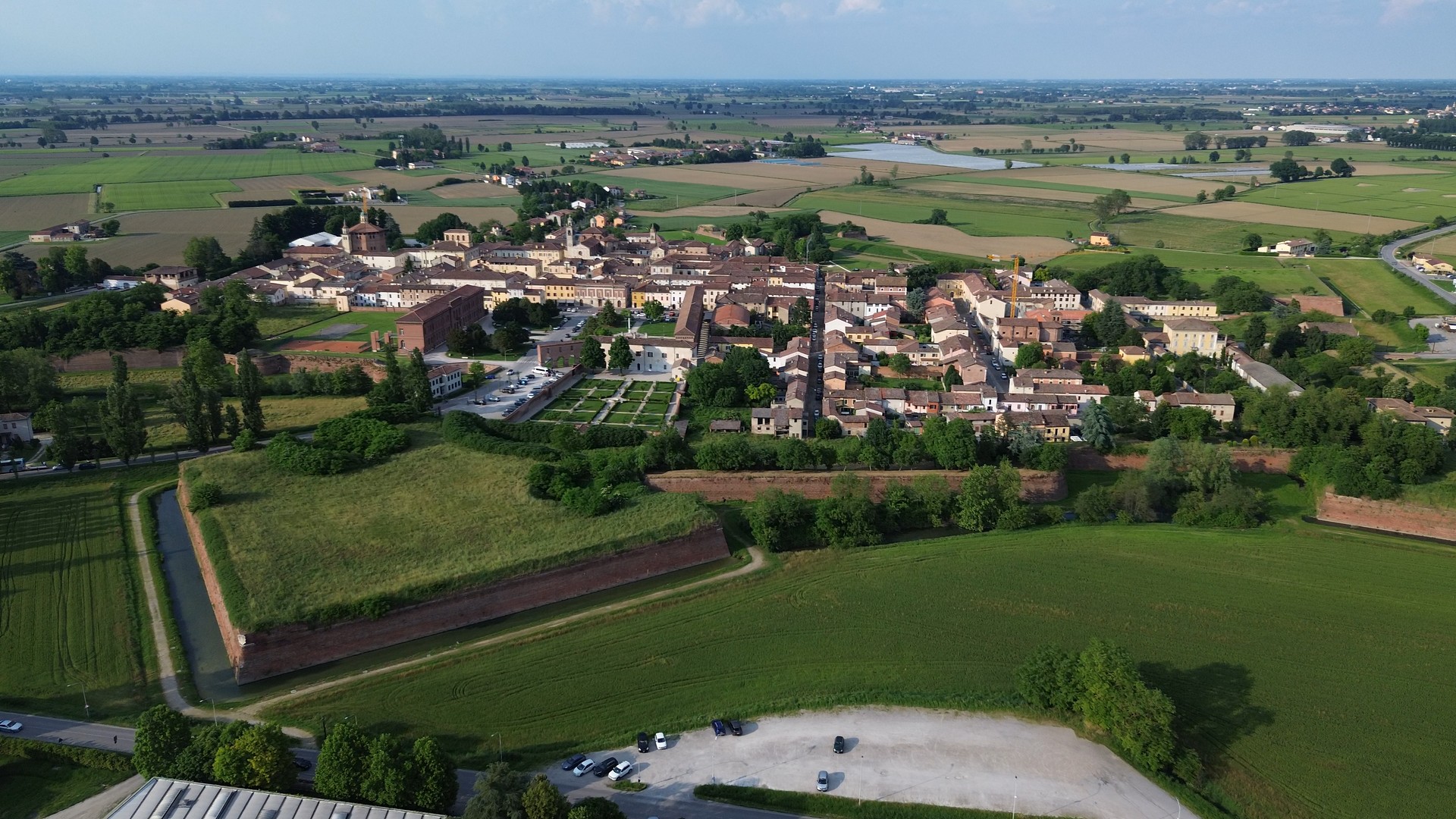
Situated on an alluvial plain in the Oltreoglio, Sabbioneta has been inhabited since the Bronze Age.
The first organized settlement dates back to the 1st century BC, perfected in oppidum from the Byzantines, in castrum from the Carolingians and finally in curtis medieval. But only when it was inherited in 1544 by the Duke Vespasian Gonzaga The small medieval village was able to transform itself, in a very short time, into a cutting-edge fortress and a refined cultural and architectural center.
In 1556 Vespasiano began to radically modify the ancient settlement, transforming it over thirty years into a skilfully organised and rationally constructed urban space, equipped with a star-shaped city wall (still almost perfectly preserved today) and with all those buildings befitting a noble residence. Sabbioneta is therefore a city of foundation, fruit of the urban planning theories of the late 16th century, expression of the spirit and culture of its founder, the idea of the city that is born perfect, takes shape as an expression of the spirit and culture of its founder Vespasian Gonzaga.
The urban layout is based on a central axis that connects the two entrances of Porta Vittoria and Porta Imperiale, on which thirty-four orthogonal blocks are hinged. Asymmetrical with respect to this axis, we find Ducal Square: political, administrative, religious center on which the minor porticoed streets and the palaces of power are orthogonally grafted. Overlooking the square, originally a market place, are Ducal Palace, the seat of political and administrative commitments, and the Church of Santa Maria Assunta, the city's cathedral. From the nearby Great Library Square you access the Church of the Incoronata, which hosts the Mausoleum of Vespasiano Gonzaga. A little further on the small Oratory of San Rocco and San Sebastiano and, hidden among the civil buildings, the Synagogue, built in 1824 as a place of worship and meeting for the Jewish community, present in the city since the sixteenth century. Nearby and equally off-axis, on parade ground some of the most representative buildings of the cultural climate of Vespasian's capital are erected: the Great Corridor and the Garden Palace, a place dedicated to leisure, study and rest. Opposite, the remains of the Fortress, the ancient fortress where the Duke had established his residence. Not far away is one of the jewels of the history of theatre in Europe, the Ancient Theater built by Vincenzo Scamozzi, the first theatre building in Italy to be built using an original factory and not as an adaptation of pre-existing halls or interiors.
Ambitious plan of one of the most eccentric princes of the late Italian Renaissance, Sabbioneta was born as ideal city, pervaded by the signs of the prince who declined in new forms the canons of classicism from which Vespasian had drawn inspiration.